Thursday, July 21, 2011

Can there be Apostles today?


Acts 1:21-26 - “Therefore it is necessary that of the men who have accompanied us all the time that the Lord Jesus went in and out among us—  22 beginning with the baptism of John until the day that He was taken up from us—one of these must become a witness with us of His resurrection.”  23 So they put forward two men, Joseph called Barsabbas (who was also called Justus), and Matthias.  24 And they prayed and said, “You, Lord, who know the hearts of all men, show which one of these two You have chosen  25 to occupy this ministry and apostleship from which Judas turned aside to go to his own place.”  26 And they drew lots for them, and the lot fell to Matthias; and he was added to the eleven apostles.

Judas is gone.  Christ has ascended and the Disciples are still waiting obediently for the Holy Spirit to come.  The next thing that needed to be taken care of was the selection of a replacement for Judas.

A 12th Apostle needed to be appointed. 

v21-22 - “Therefore it is necessary that of the men who have accompanied us all the time that the Lord Jesus went in and out among us—  22 beginning with the baptism of John until the day that He was taken up from us—one of these must become a witness with us of His resurrection.”

Following the guidelines of Scripture, Peter stands and sets out the requirements to be an Apostle.  He lays out 3 basic criteria:

1.) They had to have been “of the men” who had accompanied them all the time that the Lord Jesus went in and out amongst them.

The first stipulation was that the person had to be a person who had seen what the other Apostles had seen.  So from the baptism of Jesus by John, Peter says, and forward, the person had to have been in that group of Jesus’ followers for the three years of His public ministry.

Now, the reason for that was of course because of what they were charged with doing.  They were charged with starting churches and founding them on the truths of the Gospel and so they had to have seen it firsthand to best do that.

Second, they had to have been an eye-witness of the resurrection.
Verse 22 says that one of those men must now join them, replacing Judas to be the witness of the resurrection.

You see they were to be first hand witnesses of the resurrection which makes sense because the resurrection is the central theme of our faith!  I mean, Paul said if there is no resurrection then we have no hope and all our worship is in vain!

1 Corinthians 15:13-19 - But if there is no resurrection of the dead, not even Christ has been raised;  14 and if Christ has not been raised, then our preaching is vain, your faith also is vain.  15 Moreover we are even found to be false witnesses of God, because we testified against God that He raised Christ, whom He did not raise, if in fact the dead are not raised.  16 For if the dead are not raised, not even Christ has been raised;  17 and if Christ has not been raised, your faith is worthless; you are still in your sins.  18 Then those also who have fallen asleep in Christ have perished.  19 If we have hoped in Christ in this life only, we are of all men most to be pitied.

All of them were to be personal witnesses to Christ’s ministry, death, and resurrection.  Now, these two criteria are why, without question or subjectivity, no one can be an Apostle today.  Once more, there are NO MORE Apostles today.  Anyone claiming to be one is a liar.

Because no one is living who witnesses those things.  So the Apostolic office is closed.  But we need to note that there is one final way that someone can be an Apostle and it was the way the other 11 became Apostles and Paul himself for that matter.  That was by Divine appointment to the office by Jesus Christ Himself and later I’ll tell you why no one can make the Divine appointment claim stick today.

Well, out of all those gathered, 2 men apparently met those requirements.

v23 - So they put forward two men, Joseph called Barsabbas (who was also called Justus), and Matthias

Nothing is known about these two men really.  They aren’t mentioned elsewhere in Scripture beyond here. 

What they’ve done is narrow the options and eliminated those who didn’t qualify and so now they engage in their normal pattern of prayer to seek the will of the Lord pertaining to whom should be chosen.

v24a - And they prayed – They prayed.  What they were doing was being obedient to the Will of God by seeking Him in prayer.

That’s what they desired as believers, and so what they did was seek out God’s Word for instruction and then they prayed.  Make note of the humility in their prayer…

[And they prayed] v24b-25 –and said, “You, Lord, who know the hearts of all men, show which one of these two You have chosen  25 to occupy this ministry and apostleship from which Judas turned aside to go to his own place.”

Lord, show us the one that everyone likes or whose teaching style suits us?  No

Lord, show us the one that will tickle the people’s ears?  No

Lord, you know our hearts.  Such a truth.  Jeremiah 17:9 says that our hearts are deceitful and try to deceive us constantly.  So how appropriate that they lay that confession before the Lord first.  Lord, you know how prone to self my heart is.  So work above that.

Studying the scriptures they knew that and also they know what God said just one verse later in Jeremiah 17:10 - I, the Lord, search the heart, I test the mind, Even to give to each man according to his ways, According to the results of his deeds.

They were aware of God’s word to Samuel in 1 Samuel 16:7 - But the Lord said to Samuel, “Do not look at his appearance or at the height of his stature, because I have rejected him; for God sees not as man sees, for man looks at the outward appearance, but the Lord looks at the heart.”

Their prayer is for God to pick because they know that their hearts will taint the decision and what they want to be is obedient and true to God!

So they pray, God, you know our hearts, choose the one YOU want.

v26 - And they drew lots for them, and the lot fell to Matthias; and he was added to the eleven apostles.

Now some would suggest that this was a pagan practice, but in reality this underscores all the more how carefully they wanted to be in their selection of the replacement Apostle.  They wanted to select God’s man free from their influence.

Anyone know why that is the case?  Why I say that?

Well, what had they been doing?  Studying God’s Word right?  In Leviticus 16:8 - Aaron shall cast lots for the two goats, one lot for the Lord and the other lot for the scapegoat.

God tells Aaron that he is to “cast lots” to determine between the two goats offered for the sin sacrifice.  One would be sacrificed and the other would be the scapegoat.  Nehemiah 10, we see another example of casting lots and then in Proverbs.

Proverbs 16:33 - “The lot is cast into the lap, But its every decision is from the Lord.

The lot is cast, but its every decision is FROM THE LORD.  Casting lots was an acceptable Old Testament practice for determining God’s Will, now we don’t need it today.  Why?  Because we HAVE the Holy Spirit that enables us to best discern the will of God.  We also have the complete canon of Scripture so we have the completed written Word of God.

Casting lots was most likely putting their names on stones, placing them in a jar and shaking it around until one fell out, the one that came out would be the one that was chosen.

So the lot is cast and it falls to Matthias.  Which is gives us even more assurance that casting lots here wasn’t sinful.  God no where rebukes them for what they’ve done.

A choice is made by the providence of God.  It doesn’t fall to Matthias by change because there is no such thing as chance.  There is merely God’s sovereign rule and His providential and permissive will.

Now as a side note, you may have wondered about Paul?  Paul wasn’t an eye witness, yet Scripture identifies him as an Apostle.  Well, remember our third criteria, which is by Divine appointment.

Paul is divinely appointed, But what were the specifics of his appointing?  Acts 9 he is converted and then goes to see Annais… why?  To BE confirmed.

He had to go to the eye-witness Apostles to be confirmed by them in his calling.  He, nor anyone else, can just say.  ‘Well God called me to be an Apostle.’ and then go on with it without being confirmed by an existing Apostle.

After the Apostles all died there were still preachers and teachers and such, but no more Apostles.

Secondly, the eye-witness Apostles were called to minister specifically to whom?  The Jews right?  Paul’s chief focus was the Gentiles.

The Gospel was a stumbling block to the Jews because they denied Christ.  So eye-witness testimony would go a LONG way towards credibility for their claims to a society that was massively steeped in legalism.

To the Gentiles, the Gospel was foolishness, so no proof really would help… for them they needed to be brought first to an understanding that God was Creator, not chance or evolution, and they were in need of HIS forgiveness to be reconciled.


So no one today can be an Apostle because no eye-witnesses are living to be Apostles, nor are there any eye-witnesses alive to confirm the Divine appointment of an Apostle.  Anyone who comes to you claiming to be an "Apostle" is likely preaching a different Gospel, and a different Gospel doesn't save (Galatians 1:6-10).  Mark those and continue preaching the one true Gospel.  That Jesus COMMANDS all men to repent and trust in Him for the forgiveness of sins.  (Mark 1:15)


Thursday, June 23, 2011

Pastor's Bookshelf: It Is Well by Mark Dever & Michael Lawrence

Have you ever struggled to find the significance and beauty of the sacrifices in the Old Testament?  Most of us have at some point or another.  Mark Dever and Michael Lawrence set out to exegete crucial Old Testament texts that shadow what was accomplished by Christ on the cross.  

The truth that man MUST have a substitute for our sins in order to be spared from God's just wrath is at the very heart of the Gospel.  Dever and Lawrence bring this out in a totality from the Old Testament all the way to looking at the actual words and work of Christ in the New Testament.  From there they look at the depiction of Christ and His suffering from Isaiah 52 & 53.  Bringing it home by then looking at what God has revealed about the life, death, and resurrection of Christ.  They highlights the comprehensive and permanent nature of the salvation that God has provided by His grace.  Climaxing in the understanding that the beauty in the life of a Christian comes from understanding the Gospel more, so that we learn to enjoy God fully as our all-sufficient Savior and see the benefits of our having been redeemed as being far more precious than any mass of worldly treasures and pleasures.  In light of so great a salvation, how could we not trust Him more daily?  One last note, I definitely appreciated there thorough use of Scripture to make their points as well as their constant encouragement to unbelievers, who might be reading the book, to repent and for the believer to guard their heart against legalism and self-righteousness.

Five out of five stars!  Highly recommended!  Great for individual study or small group.

Pick it up from 9Marks Ministries or from Amazon.com

Friday, May 27, 2011

Pastor's Bookshelf: Before God: The Biblical Doctrine of Prayer by Mike Sarkissian

I realized that I never posted a review on this book after I had written the review of Paul Miller's work on prayer.  I actually completed this book months ago and most recently our church just completed a 17 week Bible study on prayer using this book to guide us through what Scripture teaches on the matter.  

Let me be on record and state that I feel that Mike's book is possibly one of the most important books written on prayer within our generation.  This book is very theological, very sound, and drives the reader back to the Bible to better understand what Jesus taught in the aptly called "Lord's Prayer".  

Mike does a very thorough job of exegeting the Lord's Prayer and unpacking the implications of each petition contained in it.  He also takes on the issues of how we pray, why we pray, and the reason why we should pray 'In Jesus Name'.  If you have not yet read this book, please put it on your list.  I would go into detail about how extensively God has used this book to shape up my own feeble prayer life, but I do not want to drift into an area of boasting as I still have much room for improvement though, by God's grace, my prayer life has improved significantly.

You can pick this up from Mike's Website or Amazon.com.

I am actually such a fan of Mike's work that I would like to get a copy of this book into someone's hands.  I am giving away a copy of this book.  To enter, comment on this post and answer the following question:  What is your largest struggle in maintaining a healthy prayer life and why do you feel that deficiency exists?

To increase your chances of winning you can:
- Re-post this review by posting it to your facebook or creating a link to this blog using the feature below.
- Follow this blog either using Google or Networked Blogs.
- Tweet this link and mention @brojasonh
 
Drawing will be held on July 1, 2011.  Please be sure that I have a way to contact you and that I know you've posted this to facebook or your blog.

Tuesday, May 24, 2011

Pastor's Bookshelf: A Taste of Heaven by R.C Sproul

What is God's intention for worship in the New Testament church?  We know of course that we are under the New Covenant of Jesus Christ and we no longer are required to practice the sacrifices and rituals as the Jews living under the Old Covenant would have.  However, does that mean that God's design for the reverence and meaning of worship have changed too?  Sproul argues that, while we obviously want to be very careful to consider the context and usage of anything from the Old Covenant before bringing it into the Church today, we can glean much deeper insight to how serious God takes the worship of His Name and how specific He was about the way we approach Him.

Though we don't go to the temple or burn incense on the altar, or take a lamb to the priest once a year to be slaughtered... the importance of those symbols (and others) hasn't simply gone away.  They serve to teach us that God expects us to approach Him with reverence and not flippantly.  That He desires sincere worship and that self-righteousness or works-boasting has no place in His courts.

This is important to consider because we live in a church culture that says pretty much anything goes.  We see so much irreverence in so many so-called churches these days.  Everything from using carnal means to get people through the doors to dumbing down the Gospel so much so that it becomes no Gospel at all (Galatians 1:6-10). 

But we must exercise careful prudence in planning how worship is structured in our church.  I'm not calling us back to a strict liturgy that would resemble the old-traditional Roman Catholic, rather saying that we need to approach everything we sing, do, and say in worship by asking the question.  Does this glorify God and point sinful man towards the Savior OR does this point sinful man towards a carnal world and excuse his sinful behavior?  

Paul wrote, in 1 Corinthians 10:31, that we should do all things to the glory of God.  This does not mean that we take a carnal thing (such as a secular song) and Christianize it for use in the church or on our local family friendly radio stations.  On the contrary it means that we need to consider all we do and filter it through whether or not this thing brings glory to God.  How we intend it isn't what determines what brings glory to God, whether or not it glorifies God is what determines whether or not it glorifies God.  We don't assign that meaning.  To get a better understanding of this, we look to Christ's words in Matthew 6:33, He said to seek first the Kingdom of God and HIS Righteousness... 

So that's the focus, seeking first that which glorifies God and that which strives after HIS righteousness... and not that which pleases us and to clear our consciences we tag God's name to it...

Lastly, He brings up the importance of the sacraments that have been ordained for the church today.  Baptism and the Lord's Supper.  Sproul presents the popular views on each and makes his case for which he ascribes to.  He and I fall pretty well in line with our belief on the Lord's Supper and it being only for a believer.  On the issue of Baptism we depart in view because, as a Presbyterian, Sproul teaches the practice of infant baptism.  Let me be clear that he absolutely rejects the idea that paedo-baptism (infant baptism) saves.  He believes infant baptism to merely be a sign of the New Covenant and not salvific.  On that we agree, it is a sign of the covenant.  But I would make the case that the New Testament teaches that Baptism, just like the observance of the Lord's Supper, is for the Believer only.

This is a great read, I give it 5 out of 5 stars for sure.  You can pick it up from Ligonier.org.

Disclosure of Material Connection: I received this book free from the publisher through the Reformation Trust <http://Ligonier.org > book review bloggers program. I was not required to write a positive review. The opinions I have expressed are my own. I am disclosing this in accordance with the Federal Trade Commission’s 16 CFR, Part 255 <http://www.access.gpo.gov/nara/cfr/waisidx_03/16cfr255_03.html> : “Guides Concerning the Use of Endorsements and Testimonials in Advertising.”

Sunday, May 22, 2011

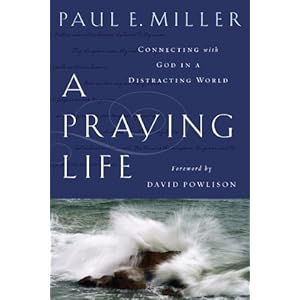
Pastor's Bookshelf: A Praying Life by Paul E Miller

Well, I must admit I did not enjoy this book as much as I had hoped.  The book started very strongly, Miller does a great job of just being real and admitting to struggles that we all feel with prayer.  After all, we are a broken and sinful people and for Christians we hate the sin that dwells within us that constantly gets at us to sin, even in the neglect of prayer.

Then he moved into the way in which we ought to pray.  It was here that I would have to, at least partially, disagree with him.  He makes a point about how we are to pray humbly, and how we are to have faith like that of a child.  I completely agree with that 100%.  However, he then continues driving that point on to infer that there is no real structure that is necessarily important in our prayers.

Now, let me say that in principle I agree with this.  In principle, there are no exact words or special phrases that we can pray that bring a miracle.  Rather it is the heart behind the prayer that God is most concerned with.  After all, Paul does say that we don't know how to pray as we ought but that the Holy Spirit intercedes on our behalf (Romans 8:26-27).  Further we know that what God desires is not empty sacrifice or empty words (Isaiah 1:10-15) but rather a broken heart and contrite spirit (Psalm 34:18; Psalm 51:17).  So in that respect I completely agree with Paul.  Please hear me, we don't have to have big fancy words or methods in our prayers. 

However, I reject the idea that there is no guidelines or prescriptions for prayer offered in Scripture.  Case in point would of course be the aptly named, Lord's prayer in Matthew 6:6-14.  Now, in fairness, Miller doesn't outright suggest that there is no guideline, however, in my opinion (whatever that is worth) he pushes the issue of a childlike prayer too far and in doing so implies what I've suggested as the problem with this part of the book.

For a more thorough handling of the subject of prayer, there are several books I would sooner recommend to you (and would be glad too if you wish to email me and request those titles).  Having said that, it is a good read and probably worth your time, just be discerning about it.

Friday, May 20, 2011

Pastor's Bookshelf: The Grace of Repentance by Sinclair Ferguson

I first became tuned in to Sinclair Ferguson's work through a children's bible study book that we have been using with our kids during family devotion times.  I amazon searched his name and found many other titles. After reading (and reviewing) By Grace Alone, another of Ferguson's titles, I became a fan.

I recently read "The Grace of Repentance" by Ferguson and it did not disappoint.  I definitely give it 5 out of 5 stars.  This book is an easy read and very convicting.  We take God's grace for granted in so many ways.  We fail to realize that it is only by God's grace that we are even able to repent and turn to God.  

Sinclair does a great job of bringing that out and bringing to light the scriptural truth behind our sin, God's mercy in offering Christ, and God's grace in forbearing our sin and granting the grace of repentance to the Christian so that they continue to bear fruit in keeping with repentance (Matthew 3:8).  

It seems to have been lost in the last generations, but this book is a fresh Biblical reminder that repentance is not just a one time thing we do when God saves us, it is a lifestyle.  Well said by Ferguson,  "A life of repentance is ongoing, dogged, persistent refusal to compromise with sin." (p.25).  Praise God for His grace and mercy in granting us repentance and allowing us the empowering of His Holy Spirit to continually turn from sin.

Available from Ligonier Ministries.